
If you want to appear on ChatGPT, the short answer is this: make your business easy for an AI to read and easy to trust. That means adding structured data that states exactly who you are, keeping your identity consistent across your website, Google Business Profile and social profiles, letting AI crawlers into your site, and writing content that answers questions directly. There's no ad slot to buy — you earn the mention by being the clearest, most trustworthy source on your topic.
We know because we just did it to our own site. This week we ran the full checklist on foundlyagency.com — an agency that sells exactly this. Below is the honest, unedited version: what we changed, why, and the actual code, so you can copy it. No results to brag about yet (we only shipped it days ago) — this is the playbook, not a victory lap.
Update — 16 July 2026. Google has since published explicit guidance (dated 10 July 2026) that changes two things on this page, and we'd rather correct them here than quietly delete them. First: Google says GEO isn't a separate product — "From Google Search's perspective, optimizing for generative AI search is optimizing for the search experience, and thus still SEO." Second: Google says it ignores llms.txt — see the correction in step 2 below. The rest of this checklist — schema, a consistent identity, letting crawlers in, answer-first content — still stands and still matches Google's own advice. The full picture, with sources, is in our 2026 SEO pricing article.
What does "appear on ChatGPT" actually mean?
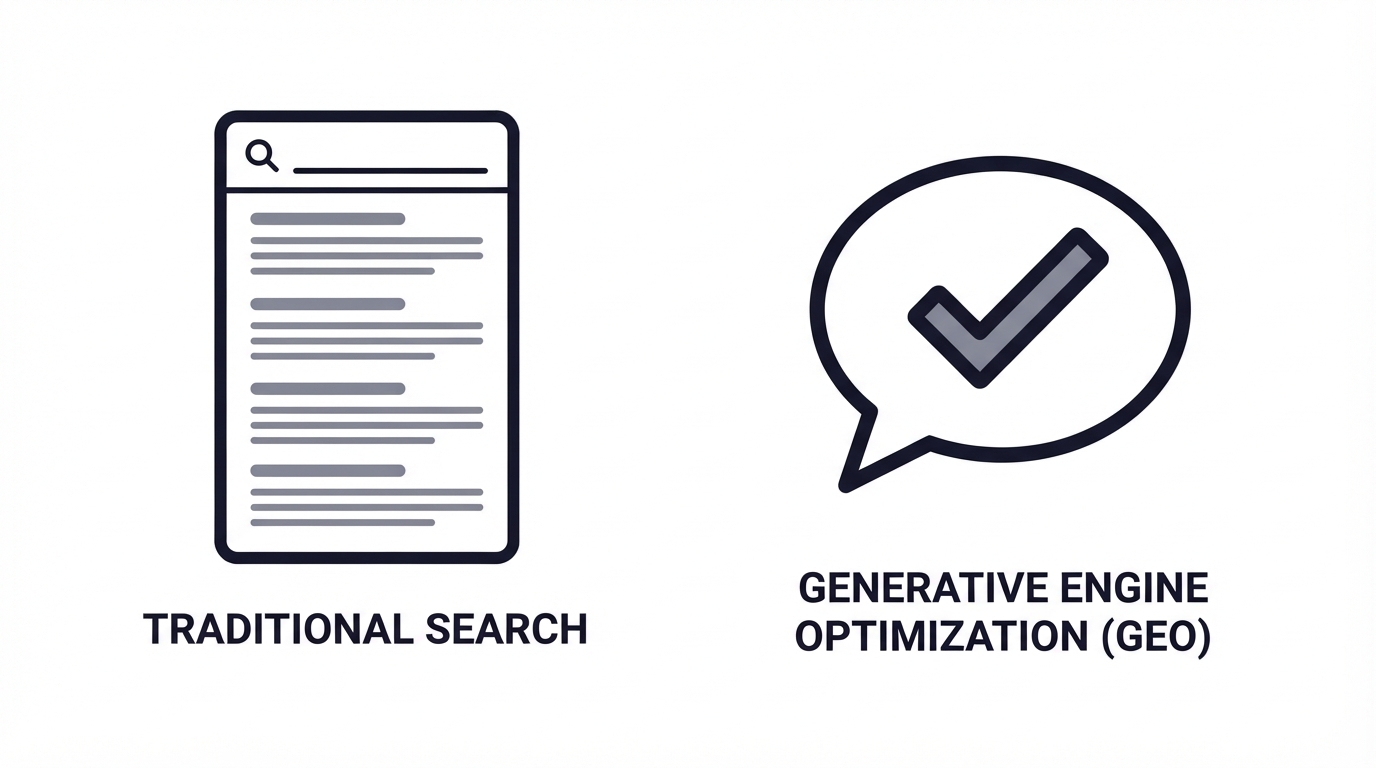
It means your business gets named inside the answer, not buried in a list of links. When someone asks ChatGPT, Gemini, or Perplexity "who does web design in Subang Jaya?" or "best POS system for a café", the engine replies with a short answer drawn from a handful of sources it trusts. Being one of those sources — being quoted — is the goal. That discipline has a name: GEO, Generative Engine Optimization — the practice of structuring your site and online presence so AI answer engines cite you.
The difference from classic search matters. On page one of Google there are ten winners. In an AI answer there is often one. Being invisible there isn't like being on page two — it's closer to not existing.
How do AI engines like ChatGPT decide who to mention?
They favour sources that are clear, structured, trustworthy, and machine-readable — and there's research to back the specifics. A 2023 study that coined the term "Generative Engine Optimization" (Aggarwal et al., Princeton) found that adding citations, quotations and statistics to a page can lift its visibility in generative-engine answers by up to roughly 40%. In plain terms, engines reward pages that state facts cleanly and prove them.
Two more facts worth knowing:
- ChatGPT's search feature runs on Bing's index, not Google's — a direct result of the Microsoft–OpenAI partnership. If Bing can't find you, ChatGPT often can't either.
- Google's AI Overviews now sit at the very top of a large share of searches, above the first traditional result — so the AI answer is increasingly the first thing your customer sees.
None of this is a trick. The engines are trying to give a good answer; your job is to be the obvious source of one.
The GEO checklist we ran on our own site
Here is exactly what we changed on foundlyagency.com — the same six moves we'd run for any client.
1. We told machines who we are, in structured data
We expanded our site's schema into a full business identity — founder, location, languages, price, contact, and a machine-readable list of services — so an engine doesn't have to guess. The key line for AI is sameAs, which links the business to every profile it owns:
{
  "@type": "ProfessionalService",
  "@id": "https://foundlyagency.com/#organization",
  "name": "FoundlyAgency",
  "founder": { "@type": "Person", "name": "Lawrence Kang Chee Keong" },
  "knowsLanguage": ["English", "Chinese", "Malay"],
  "sameAs": [
    "https://www.instagram.com/foundlyagencyy/",
    "https://www.facebook.com/foundlyagencyy",
    "https://www.youtube.com/@foundlyagency"
  ]
}
sameAs is how you tell an AI "all of these accounts are the same business." It connects the dots across the web into one confident identity — which is exactly what an engine needs before it will name you.
2. We added an llms.txt file — and here's the honest correction
llms.txt is an emerging convention — a plain-language file at yoursite.com/llms.txt that hands AI crawlers a clean summary of who you are and what you offer. We wrote one covering our services, location, languages, pricing, and key pages.
Update, 16 July 2026 — we were too optimistic about this one. Google has since stated plainly that it ignores these files. From Google's Guide to Optimizing for Generative AI Features (updated 10 July 2026):
"You don't need to create new machine readable files, AI text files, markup, or Markdown to appear in Google Search... Doing so will neither harm nor help your site's visibility or rankings in Google Search, as Google Search ignores them."
Precisely, then: llms.txt does nothing for Google — including AI Overviews and AI Mode. Its only possible value is with non-Google engines that choose to read it, and we have no evidence that any of them meaningfully do. We've left ours up because it costs nothing and breaks nothing, but we won't pretend it's a lever. If an agency sells you a "GEO package" whose centrepiece is this file, you are buying something Google explicitly ignores. More on what Google now says about GEO — and what it costs — in our 2026 pricing article.
3. We made our identity consistent everywhere
We finished our Google Business Profile — every service written out, service areas set, categories and hours correct — and pointed our website, profile and social links at the same facts. AI engines cross-check sources; when your name, contact and details match everywhere, you read as trustworthy. When they conflict, you read as noise.
4. We let AI crawlers in
We confirmed our robots.txt welcomes AI crawlers (GPTBot, PerplexityBot, and others) instead of blocking them, and verified the site in Bing Webmaster Tools — because, as above, that's the index ChatGPT reads from.
5. We wrote answer-first
Every important page now leads with the answer in the first line, uses real question-shaped headings, and states facts plainly — the format engines find easiest to lift. (This very article is built that way.)
6. We turned on measurement
We added analytics so we can track what happens next — because the only honest way to judge GEO is to measure it, not to assume it worked.
How can you check if you appear on ChatGPT today?
Ask the engines your own customers' questions and see who gets named. Open ChatGPT, Gemini and Perplexity and type the questions a buyer would ask about your industry and area — "who does [your service] in [your town]?" If a competitor is named and you aren't, that's your scoreboard, and your to-do list. If you'd rather not do it by hand, our free visibility check tests exactly this and shows you where you stand across Google, Maps and AI.
We ran exactly this test on a client, twice, fifteen days apart, and wrote down both results — including the run where the engine named four competitors and not them, and how few sessions the win was actually worth.
How long until this works?
Expect weeks, not days — and be suspicious of anyone who promises faster. Engines have to re-crawl your site, notice the new structure, and build confidence in your identity before they'll cite you. GEO is a compounding asset: the groundwork we laid this week keeps paying off as the engines catch up, the same way a well-built website keeps earning long after launch. We'll re-run the tests in a few weeks and update this page with what we find — honestly, whichever way it goes.
If you'd rather skip the DIY and have it done properly, that's our whole job. See what AI Search (GEO) involves, check our plans and pricing, or get a free visibility check and we'll show you exactly what to fix first.
Frequently asked questions
How do I get my business to appear on ChatGPT? Make your business easy for AI to read and trust: add structured data (schema) that states exactly who you are, keep your name, contact details and links consistent everywhere, let AI crawlers access your site, and publish clear, answer-first content. There's no ad to buy — you earn the mention by being the clearest, most trustworthy source.
Does ChatGPT use Google or Bing to find businesses? ChatGPT's built-in search draws on Microsoft Bing's index, not Google's. So getting your site verified and indexed in Bing Webmaster Tools directly affects whether ChatGPT can find and cite you.
How long does it take to appear in AI answers? Weeks, not days. AI engines need to re-crawl your site and build confidence in your identity. Anyone promising you a spot in ChatGPT overnight is bluffing — this is a compounding play, not a switch you flip.
Is GEO different from SEO? Yes. SEO fights for a ranking position on a page of ten blue links. GEO fights to be the single answer an AI engine actually says. The groundwork overlaps, but the goal — being quoted, not just ranked — is new.
Curious whether you show up when people ask AI about your business? Start with a free visibility check — we'll test Google, Maps and AI, and show you exactly where you stand.